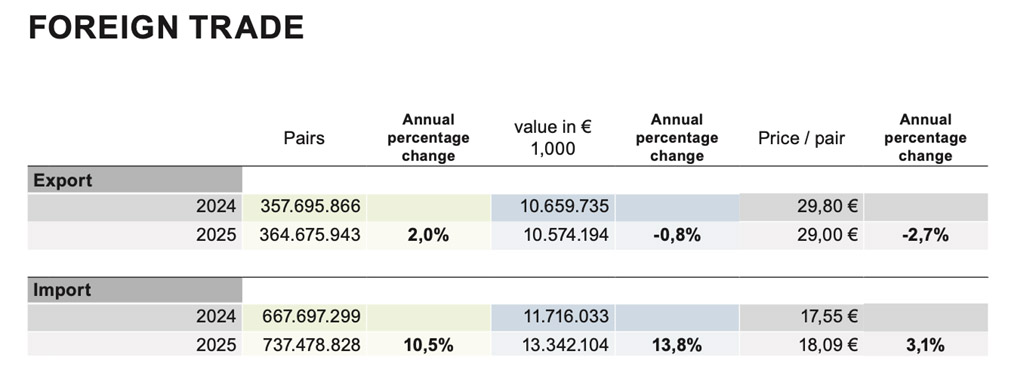
As in previous years, Poland was the most important destination for shoes from Germany. In the whole year of 2025, 72.9 million pairs of shoes were exported from Germany to Poland, representing an increase of 8.1 percent. Export growth has been recorded in the following countries: France (+7.5 percent to 40.9 million pairs) and Spain (+15.1 percent to 20.9 million pairs). In 2025, Italy was the fourth most important export destination for shoes from Germany. Here, an increase in the export is observed with 1.5 percent to 28.3 million pairs. This growth is driven by street shoes with a textile upper (+9.6 percent to 9.2 million pairs).
With the second presidency of Donald Trump and the introduction of extensive additional tariffs, the trade policy of the US has shifted more clearly than ever toward protectionism. For the German footwear and leather goods industry, the new US tariff policy entails additional costs, bureaucracy, and considerable uncertainty. However, despite all political tensions, the United States remains an important trading partner. While 14.6 million pairs of shoes were exported to the US in 2024, 17.8 million pairs of shoes were exported to the US in 2025. This corresponds to an increase of 21.3 percent.
Imports
In 2025, 10.5 percent more shoes were imported compared to the last year. Hereby, 737.5 million pairs of shoes were imported in Germany. The import value rose from 11.7 to 13.3 billion Euros, which corresponds to an increase of 13.8 percent. Massive increases were observed for shoes with a textile upper (shoes with a textile upper: +19.3 percent to 281.7 million pairs). Whilst the import of leather upper shoes increased by 7.6 percent to 184.9 million pairs from 2024 to 2025.
In terms of number of pairs, China is the most important importer of shoes, accounting for 41.5 percent of all shoes imported in Germany. Compared to 2024, imports of footwear from China to Germany rose by 6.8 percent from 286.8 to 306.4 million pairs. Significant increases in shoe imports have been recorded for Vietnam and Indonesia. Both countries have seen an increase about one fifth. While 122.5 million pairs of shoes were imported from Vietnam to Germany in 2024, 149.2 million pairs were imported during the whole year of 2025. This corresponds to an increase of 21.8 percent. One in five shoes imported into Germany comes from Vietnam (import share: 20.2 percent). The number of shoes imported from Indonesia to Germany rose by 21.2 percent to 46.0 million pairs. While there is a growth in shoe imports from Myanmar and Cambodia (Myanmar: +12.7 percent to 27.3 million pairs; Cambodia: +18.3 percent to 19.3 million pairs), India and Bangladesh saw a decline in their export of shoes to Germany (India: -2.1 percent to 21.5 million pairs; Bangladesh: -5.1 percent to 16.2 million pairs).
Increases in the import from European countries such as Italy, Portugal and Spain have been recorded (Italy: +5.2 percent to 23.5 million pairs; Portugal: +16.7 percent to 14.8 million pairs; Spain: +35.0 percent to 10.5 million pairs). The trend from the first half of the year was confirmed for the full year. The import in Germany of Italian shoes with a leather upper increased by 8.5 percent to 10.9 million pairs. This is mainly driven by shoes with leather upper for women, where 5.5 million pairs have been imported in Germany from Italy. This is a plus of almost a third from 2024 to 2025 (+32.7 percent). At the same time, the importance of shoes from Italy with a textile upper for the German import of shoes increased (+16.8 percent to 6.2 million pairs).
Leather Goods Industry
Exports
In 2025, leather goods and luggage worth 2.7 billion Euros were exported from Germany. This represents a decline of 1.6 percent compared to 2024. Exports developed positively in the case of luggage, for example for travel bags with an exterior made of textile (+4.2 percent to 400.8 million Euros).
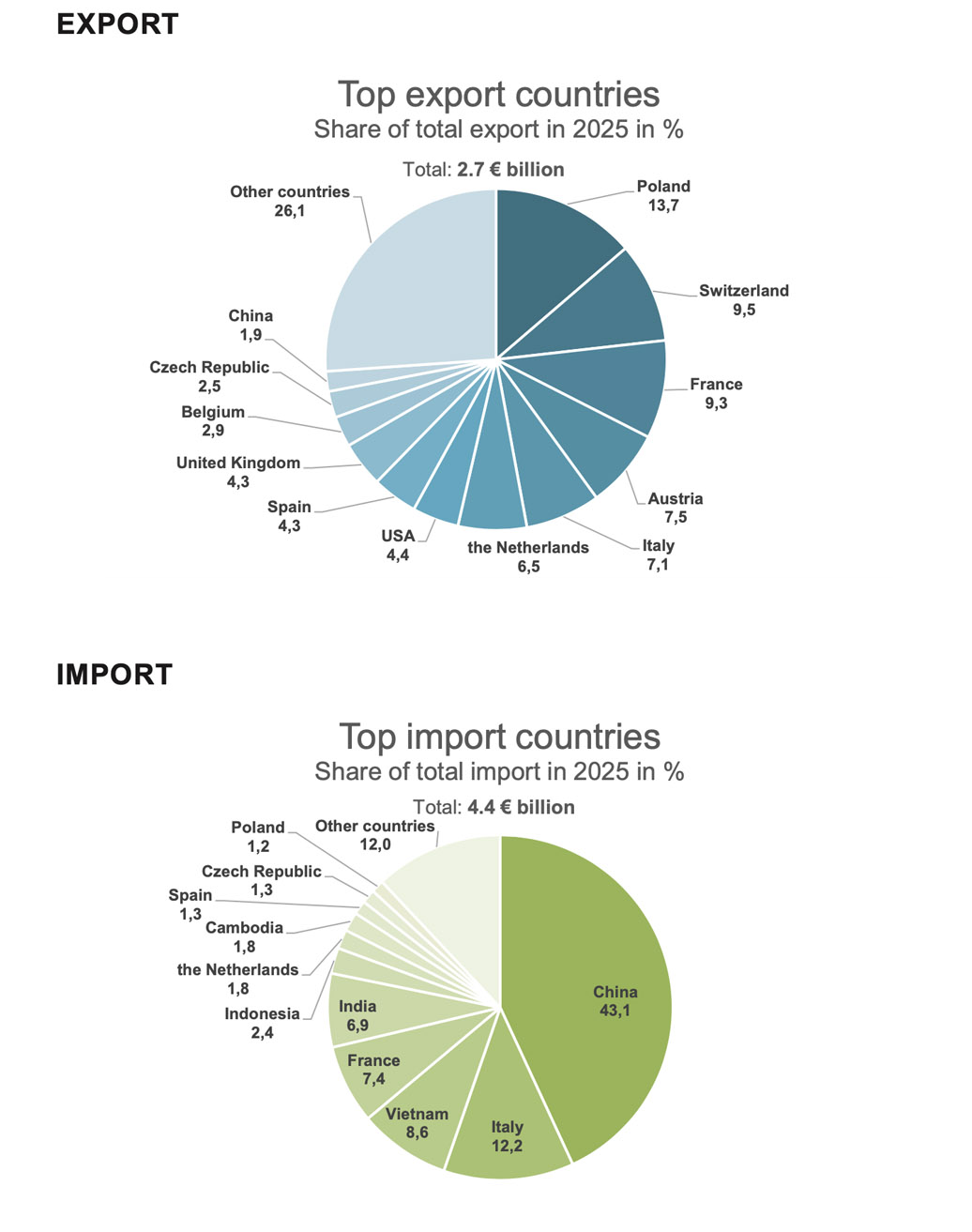
The most important export countries of 2025 were Poland, Switzerland, and France (Poland: -2.1 percent to 373.7 million Euros; Switzerland: +8.3 percent to 260.3 million Euros; France: +2.1 percent to 253.4 million Euros). Italy is the fifth most important export country for German leather goods producers with a share of 7.1 percent on the exported leather goods from Germany. For the whole year of 2025, leather goods with a value of 193.4 million Euros were exported to Italy. Compared to 2024, this represents a decline of 8.3 percent.
As in the first half of 2025, exports to countries outside the EU single market developed in different directions for the whole year of 2025. While there were increases in the value of exports to the United Kingdom and the United States of America, there were declines for China (United Kingdom: +15.1 percent to 116.2 million Euros; United States of America: +2.1 percent to 121.6 million Euros; China: -17.6 percent to 53.1 million Euros).
Imports
Compared to 2024, the value of total imports of leather goods, suitcases, and luggage rose by 8.3 percent in 2025. The value of imported goods grew from 4.14 to 4.48 billion Euros. Across major product groups, also in the area of luggage, there has been an increase in the value of goods. As an example, the import value of travel bags with an exterior made of textile and briefcases made of moulded plastic rose by 4.0 percent to 623.5 million Euros and respectively by 5.6 percent to 340.7 million Euros.
China was in 2025 Germany‘s most important supplier of leather goods, suitcases, and luggage, as in 2024. Leather goods worth 1.9 million Euros were imported from China into Germany, with the import value rising by 10.6 percent compared to whole year of 2024. The share of Chinese imports represents 43.1 percent of the total import value of leather goods imported in Germany. While the import from Vietnam remains stable (+0.5 percent to 385.2 million Euros), there are increases for India, Indonesia and Cambodia (India: +12.6 percent to 310.0 million Euros; Indonesia: +20.0 percent to 108.4 million Euros; Cambodia: +13.2 percent to 79.2 million Euros).
Italy was the second most important supplier of leather goods and suitcases to Germany in 2025. While leather goods and luggage worth 544.7 million Euros were imported from Italy to Germany in 2024, the value of imported goods in 2025 amounted 547.9 million Euros. This corresponds to a slight plus of 0.6 percent. However, this is accompanied by a lower import of leather handbags from Italy in Germany. In 2024, Germany imported around 1.1 million leather handbags from Italy, but by 2025, this number had surged to 9.6 million. In terms of units, this amounts to a 15.1 percent decline.
Outlook
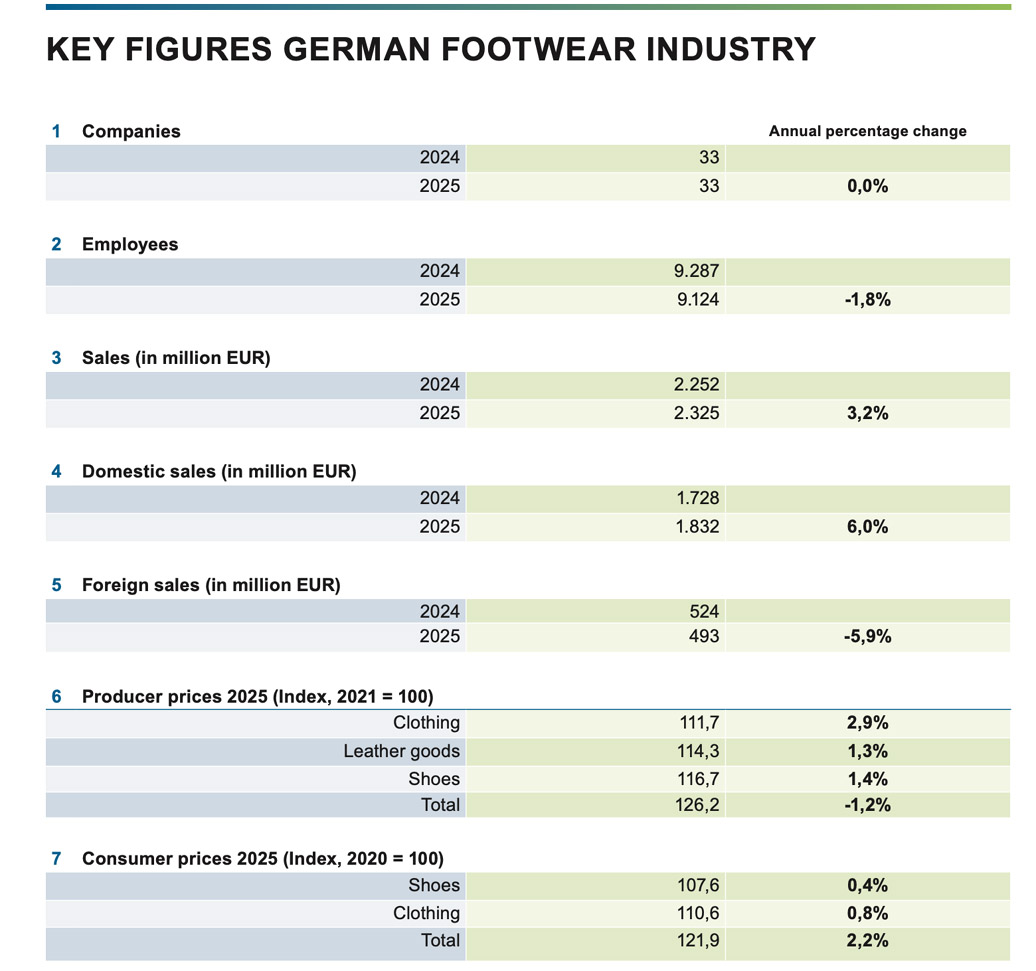
Forty percent of the companies participating in the HDS/L economic survey expect their revenues in 2026 to remain at the same level as in 2025. Stability is provided by international business. One in two companies is planning at the same level with regard to export business in 2026 compared to the previous year.
Companies in the sector are facing a wide range of business risks that are making economic activity more difficult. Domestic demand has been identified by three out of four companies as the greatest risk. Bureaucracy also plays a decisive role: 70 percent of companies view economic policy conditions as a risk to their company’s economic development over the next six months. In addition, rising labour costs represent another major business risk for half of the companies.
At the same time, decent opportunities may arise for the sector both domestically and internationally. Domestic tourism continues its upward trend. In 2025, accommodation providers recorded a total of 497.5 million overnight stays. This figure is 0.3 percent above the previous record of 465.1 million overnight stays in 2024. The robust growth path in air transport also continued in 2025. From January to November 2025, 204.06 million passengers used German airports. This corresponds to an increase of 3.5 percent compared to the same period of the previous year. Nevertheless, passenger volume still remains 12.5 percent below the level of 2019.
Geopolitical uncertainties and increasing trade conflicts are leading to further restraint in purchasing and investment. One third of the surveyed companies in the sector are planning not to make any investments in the next twelve months. New momentum could be generated by free trade agreements with dynamic economic regions of the world such as India and Indonesia. These free trade agreements are more important than ever. Following the political conclusion of negotiations between the EU and India, the next steps must now be taken swiftly, so that the agreement can enter into force as soon as possible. However, trade agreements can only benefit companies if they are balanced and fair.
Numerous initiatives under the EU Green Deal have revealed practical shortcomings as well as massive bureaucratic requirements. The postponement of the EU Deforestation Regulation was a necessary step to provide short-term relief. “Companies finally need planning certainty, practical rules, and a reduction to what is absolutely necessary,” demands HDS/L Managing Director Torben Schütz. The footwear and leather goods industry has clear expectations of both European and German policymakers: cutting red tape must not remain mere lip service but must be implemented decisively. At the federal level in Germany, concrete measures must finally follow the announcement of the unrealized “Autumn of Reforms,” enabling companies to gain new room for manoeuvre.
Despite the tense economic situation, certain Asian companies continue to enter the EU single market unhindered via online platforms. Their products often reach end customers without regulatory controls. There is no level playing field for local companies. To ensure fair competition, legal responsibility must be established for companies that sell products directly to consumers within the EU, and liability and insurance requirements must also be introduced for companies from third countries. Recently, the EU Commission launched an investigation into Shein under the Digital Services Act (DSA). The European Commission’s proceedings under the DSA must be concluded swiftly.
Source: Federal Statistical Office, Wiesbaden (destatis.de)