THE INTERNATIONAL SCENE
The first half of 2026 played out against an international backdrop still marked by geopolitical uncertainty, trade tensions, and a shifting balance in global trade.
Tariff policies and trade barriers continue to influence corporate strategies and trade flows, particularly toward the United States.
Against this backdrop, the International Monetary Fund’s most recent projections indicate global economic growth of 3.0% in 2026, rising to 3.4% in 2027.
An overall picture of resilience, but markedly uneven across regions and countries: according to the IMF, the effects of the war and the energy shock weigh most heavily on energy-importing and more vulnerable economies, while demand driven by artificial intelligence mainly supports countries more deeply integrated into global technology value chains.
World trade, too, is expected to slow after the strong growth recorded in 2025: according to the IMF, the growth in the volume of trade in goods and services is projected to fall from 5.0% in 2025 to 3.5% in 2026, before bouncing back to 4.3% in 2027.
For the Italian eyewear industry, which is heavily oriented toward foreign markets, the growing diversification of international economic dynamics makes it even more strategic for companies to diversify their target markets, consolidating their positions in traditional areas while developing new opportunities.
ITALIAN EYEWEAR EXPORTS IN THE FIRST HALF OF 2026
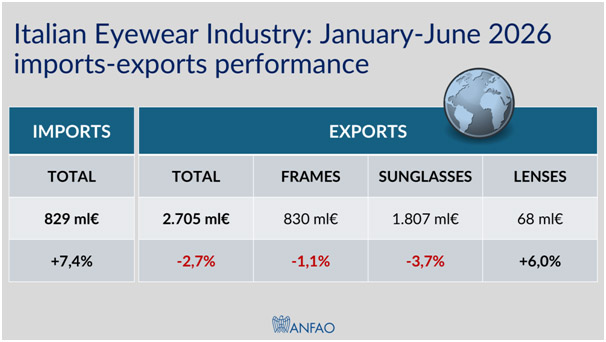
From January to June 2026, total Italian eyewear exports—frames, sunglasses, and lenses—totaled just over 2.7 billion euros, a fall of 2.7% compared to the same period in 2025:
- sunglasses exports totaled approximately 1.81 billion euros, down by 3.7%;
- frame exports reached approximately 830 million euros, a fall of 1.1%;
- lens exports—for a relatively insignificant value of approximately 68 million euros—grew by 6.0%.
On the imports front, the first half of 2026 recorded overall growth of 7.4% compared to the same period in 2025, totaling approximately 982 million euros.
The trade balance for the industry, however, remained largely positive, at over 1.7 billion euros.
A GRADUALLY IMPROVING MONTHLY TREND
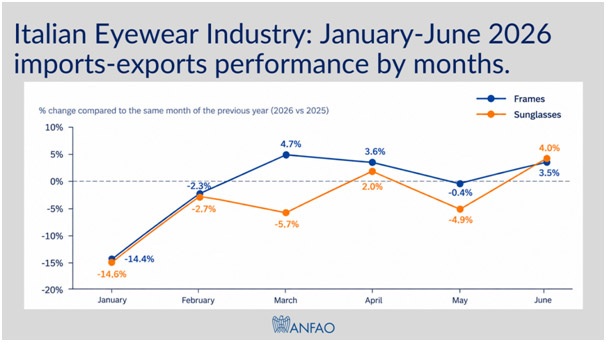
Aside from the cumulative half-year figure, it is the monthly trend in exports, above all, that is offering encouraging signs.
After the sharp decline recorded in January (-14.3%), the gap compared to 2025 narrowed significantly in the subsequent months: -2.6% in February and -1.9% in March, before actually rising in April (+3.0%).
June was particularly significant for Italian eyewear exports, closing at +3.7%, with positive trends for both frames and sunglasses. While this trend should be interpreted with caution, it indicates a gradual recovery from the sharp decline recorded at the beginning of the year and offers more encouraging signs looking ahead to the second half of 2026.
EXPORTS IN THE FIRST HALF OF 2026: GEOGRAPHICAL AREAS
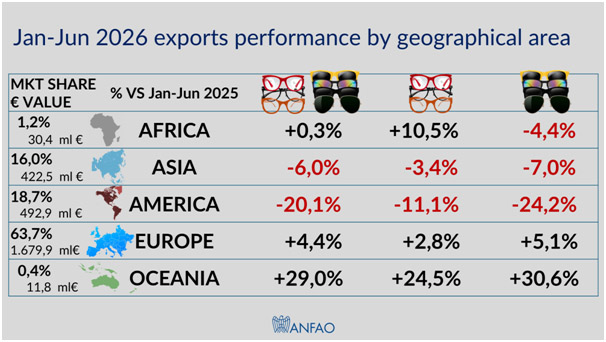
When considering the two main segments of the industry—frames and sunglasses—together, the differing trends across the major geographic regions stand out clearly:
- Europe remains the primary destination for Italian eyewear exports, recording 4.4% growth in the first half of the year compared to the same period in 2025. Within the area, the European Union grew by 3.7%, confirming the strength of demand in the continent’s major markets.
- The trend in the Americas was the opposite, with a 20.1% decline, heavily influenced by the performance of North America (-24.3%) and, in particular, the United States.
- Asia as a whole recorded a 6.0% fall, with varying trends across individual markets.
UNITED STATES: THE IMPACT ON EXPORTS REMAINS STRONG
The United States, historically the leading destination market for Italian eyewear, continued to represent the main source of pressure on overall export performance in the first half of 2026.
From January to June, Italian exports of frames and sunglasses to the U.S.totaled approximately 320 million euros, down by 25.1% compared to the same period in 2025. This decline amounts to over 107 million euros in lost exports and continues to reflect a complex trade environment marked by significant uncertainty regarding access conditions to the market.
The impact of the U.S. market on the overall result is particularly evident: excluding the United States, Italian exports of frames and sunglasses to the rest of the world would have shown overall growth compared to the first half of 2025. This figure highlights, on the one hand, the significance of the decline in exports to the U.S. and, on the other, the industry's ability to at least partially offset its effects through greater geographic diversification of exports.
EUROPE CONFIRMS ITS POSITION AS THE MAINSTAY FOR EXPORTS
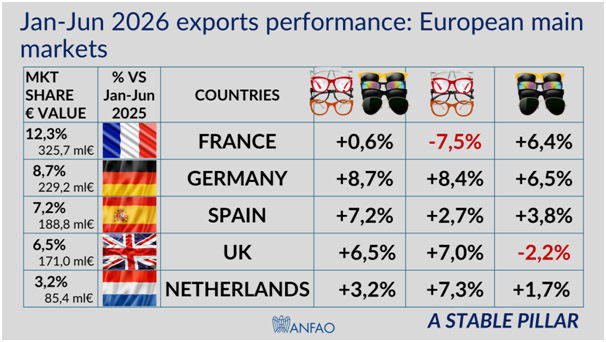
Europe’s resilience is one of the most significant elements of the first half of the year.
France recorded approximately 326 million euros in exports of frames and sunglasses, with an increase of +0.6%, confirming its status as one of the key markets for the Italian eyewear industry.
Performance was particularly strong in Germany (+7.1%) and Spain (+3.5%).
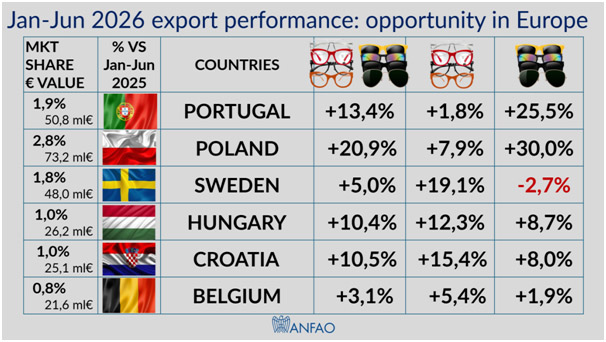
Very strong results were also recorded in other European markets, including Portugal (+13.4%) and, above all, Eastern European countries: Poland (+20.9%), Hungary (+10.4%), and Croatia (+10.5%).
The widespread growth across various countries thus confirms Europe’s role not just as a stable region, but also as a central element in the process of geographically rebalancing Italian eyewear exports.
INTERNATIONAL MARKETS: OPPORTUNITIES AND VARYING TRENDS
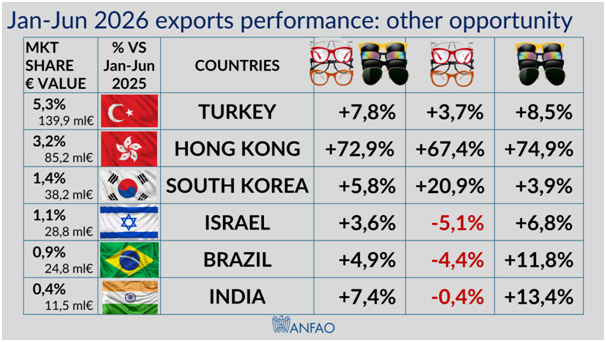
Outside Europe, the picture is more mixed. Among the growing markets, Turkey stands out (+7.8%), while Hong Kong’s performance is particularly significant (+72.9%)—a figure that should, however, be interpreted in light of the market’s role as a major commercial hub for the Asian region.
Conversely, some markets that had positive results in 2025 are now in decline: China (-22.8%), Mexico (-20%), and the United Arab Emirates (-20.9%). These trends should be interpreted in light of the specific conditions of individual markets and a particularly volatile international environment: from increased consumer caution and selective demand in China, to the geopolitical tensions affecting the Middle East, which are also having repercussions on consumption and trade flows in the area. In the case of Mexico, this result follows the double-digit growth recorded in 2025.
Overall, this performance confirms the need to maintain a broad and diversified market portfolio.
THE DOMESTIC MARKET IN THE FIRST HALF OF 2026
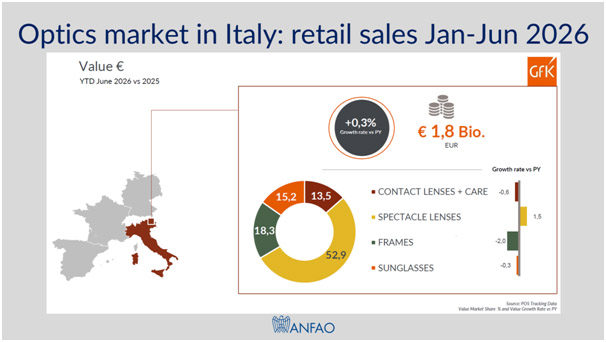
On the domestic front, sales figures from the optical retail channel paint a picture of substantial stability in the first half of 2026: according to NIQ-GfK surveys, the Italian optical market reached a value of approximately 1.8 billion euros, showing a slight increase (+0.3%) compared to the same period in 2025.
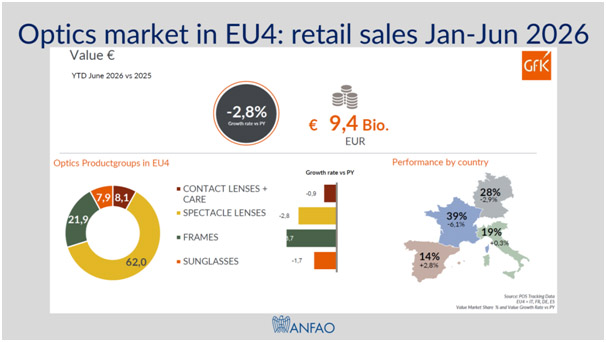
This trend stands out positively against the backdrop of the major European markets, where overall sales fell by 2.8%.
Within the Italian market, trends varied across different segments. Ophthalmiclenses, which account for more than half of the market’s total value, grew by 1.5%, while frames fell by 2.0% and sunglasses remained practically stable (-0.3%).
Within the ophthalmiclenses segment, the performance of progressivelenses was particularly positive, with a 2.0% increase in volume and a 2.4% increase in value over the first half of the year, as demand continues to focus primarily on mid-to-high-end products.
OUTLOOK FOR THE SECOND HALF OF 2026
“The figures for the first half of the year call for caution but offer some encouraging signs,” commented Lorraine Berton, President of ANFAO.“Overall figures continue to be strongly affected by the difficulties in the U.S. market, but the gradual improvement in monthly performance and, above all, the ability of our companies to grow in Europe and other markets demonstrate once again the strength and adaptability of the Italian eyewear industry. Market diversification is no longer just an opportunity, but a fundamental component of our companies’ competitiveness. The United States remains a strategic market for the industry, and we will continue to monitor its evolution very closely; at the same time, however, we must consolidate the positions we have achieved in Europe and continue to develop new international opportunities. In this regard, the figures for April to June offer a positive sign, which we view with confidence but without underestimating the complexity of the situation.”
The second half of the year thus begins in a complex scenario, where elements of uncertainty persist, but with signs of stabilization and recovery emerging.
“The Italian eyewear industry’s ability to promote ‘Made in Italy’, manufacturing quality, design, innovation, and the international positioning of its companies will continue to be a key factor in tackling the evolution of global markets,” added ANFAO President Lorraine Berton.
Summary of the data
Methodological note on data and sources: ANFAO analysis based on data from Istat, Euromonitor International and NIQ-GfK. Data available for the period January-June 2026.